Trust relationships in an Active Directory infrastructure are among the most advanced mechanisms that enable a secure authentication flow across different domain or forest boundaries. This structure removes the technical boundaries of organisational separation and allows user identities to be validated against resources in another domain or forest as well. Especially in multi-layered and large Active Directory topologies, matters such as how communication between forests takes place, at what level authentication processes are shared and how far this communication extends depend on designing the trust model correctly. At this point, the difference between a forest trust and an external trust becomes decisive for the balance between security and access in the architecture.
A forest trust is a trust relationship that is established between the root domains of 2 separate forests and that allows authentication requests to flow transitively across the forests. It is defined at the forest level and makes it possible for all domains in both forests to trust each other. It is preferred in particular for company mergers, corporate integrations or multi-forest structures that need central management. In this model, which works through the referral logic of the Kerberos protocol, an authentication request from 1 forest can be referred to the other forest, and during this process the user identity remains valid along the whole domain chain that the trust relationship permits. A forest trust that has been established once therefore acts as a bridge between the 2 forests and provides management of access to resources and continuity of authentication.
An external trust, in contrast, is a non-transitive trust model that is established between 2 domains in different forests and is valid only between that pair of domains. This structure keeps the trust limited to a specific scope and prevents it from extending to the forest level. It is generally preferred for cooperation between organisations, temporary connections or migration periods. Instead of covering a whole forest, an external trust creates a secure communication path only between the specified domains, so access control can be managed much more tightly.
Both trust types have the same basic goal: to allow identities to be validated in a central trust model. However, the first extends this trust to the forest level, while the second limits it to the domain level. This difference is not only a matter of technical scope; it is also an architectural choice that determines how the access strategy is shaped. A forest trust offers administrative unity in large and integrated structures, while an external trust provides narrower but controlled access. Which trust type is used in an Active Directory environment depends not only on the size of the topology but also on a strategic decision about how far the trust is allowed to extend.
Now let us examine in technical detail how this structure works, at which stages the trust relationship is used and how the authentication scope is determined.
For a trust relationship to work correctly, the domain controllers on both sides must be able to resolve each other's DNS names. For this reason, configuring a conditional forwarder or a stub zone between the 2 sides is a technical prerequisite before the trust is created. Otherwise, the trust creation wizard returns errors such as "The specified domain either does not exist or could not be contacted".
1- Forest Trust (Transitive - Forest to Forest)
A forest trust is the most comprehensive trust relationship. It is established between 2 separate forests and allows authentication traffic to flow transitively between all domains of both structures. In this model, although the trust is defined only between the root domains, its scope extends to the whole forest. This means that a forest trust established between a.com and b.com also automatically covers all child domains such as ist.a.com, ank.a.com, ist.b.com and ank.b.com. This propagation takes place through the referral ticket mechanism of the Kerberos protocol; when an authentication request from 1 forest is referred to the other forest, the authentication remains valid through the TGT (Ticket Granting Ticket) chain.
This structure is preferred especially in large organisations or in scenarios where more than 1 forest must operate under a central trust structure. The reason is that a transitive trust established at the forest level removes the administrative need to define a separate trust between each pair of domains. In addition, access policies, authorisation decisions and Group Policy scopes can be evaluated centrally within this trust chain.
The most important characteristic of a forest trust is that, because of its transitivity, all domains in the 2 forests can refer authentication requests directly. As a result, when a user who has signed in to a domain in their own forest requests access to resources in the other forest, the authentication process can complete without an additional trust definition or manual referral. This reduces the administrative workload and also creates an access architecture that is fully compatible with the Kerberos trust model.
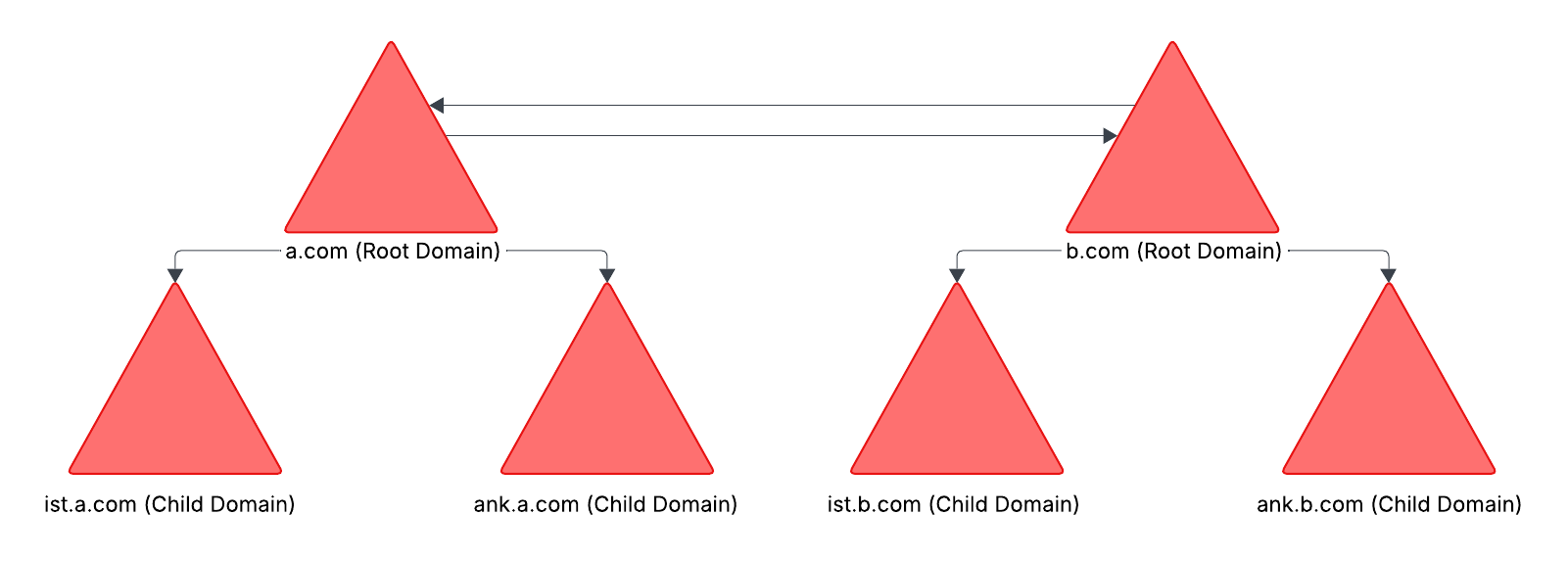
The red colours in the diagram represent the domains within the scope of the transitive trust. In a forest trust structure, although the trust relationship is defined only between the root domains, the transitive property extends it automatically to all child domains.
The transitivity of a forest trust applies to the 2 forests inside a single trust relationship; it does not work in a chained way across more than 1 forest trust. This means that the forest trust established between a.com and b.com automatically covers, through transitivity, all child domains under both forests (ist.a.com, ank.a.com, ist.b.com, ank.b.com). However, if a 3rd forest is added later (for example c.com), the b.com ↔ c.com trust is not sufficient for a.com to trust c.com; a direct a.com ↔ c.com forest trust must also be established.
In addition, to create a forest trust, the forest functional level of both forests must be at least Windows Server 2003, and the account that creates the trust must have Enterprise Admin (or equivalent) permissions on both sides.
|
Configuration |
Trust direction: a.com ↔ b.com (forest trust)
Authentication type: Forest-wide or Selective |
|
Result |
✔ The trust relationship is established at the forest level, and both the root domains and all child domains (ist.a.com, ank.a.com, ist.b.com, ank.b.com) are inside this trust scope.
✔ Because the trust is transitive, authentication is automatically valid between all domains in both forests. |
2- External Trust (Non-Transitive - Root to Root)
An external trust is a non-transitive trust relationship that is established between domains in 2 different forests and is valid only between that pair of domains. In this model, the trust does not extend to the forest level; authentication is possible only between the specified domains. When it is established between root domains, as in the a.com and b.com example, the trust is active only between these 2 domains, and the other domains under both forests (for example ist.a.com or ank.a.com) are not automatically affected by this relationship.
This structure is generally used in scenarios that require limited access between 2 different organisations. For example, to access specific resources of another organisation, a company can establish a trust relationship only between the root domains. As a result, authentication takes place only within the permitted domain boundaries, and the risk of propagation across the forest is removed. Because an external trust has no transitivity, referral ticket forwarding is not possible. This means that a user can use the credentials of their own domain to access resources only in the domain on the other side of the trust, and cannot reach the child domains of that domain.
This behaviour allows security to be controlled granularly. Unlike a forest trust, an external trust is limited to the domain level, so the administrator can state explicitly which domains have access to each other. It is preferred especially during migration periods, in temporary access designs or when full integration of the Active Directory structures of different organisations is not wanted. In summary, an external trust offers an isolated, controlled and predictable trust model at the domain level.
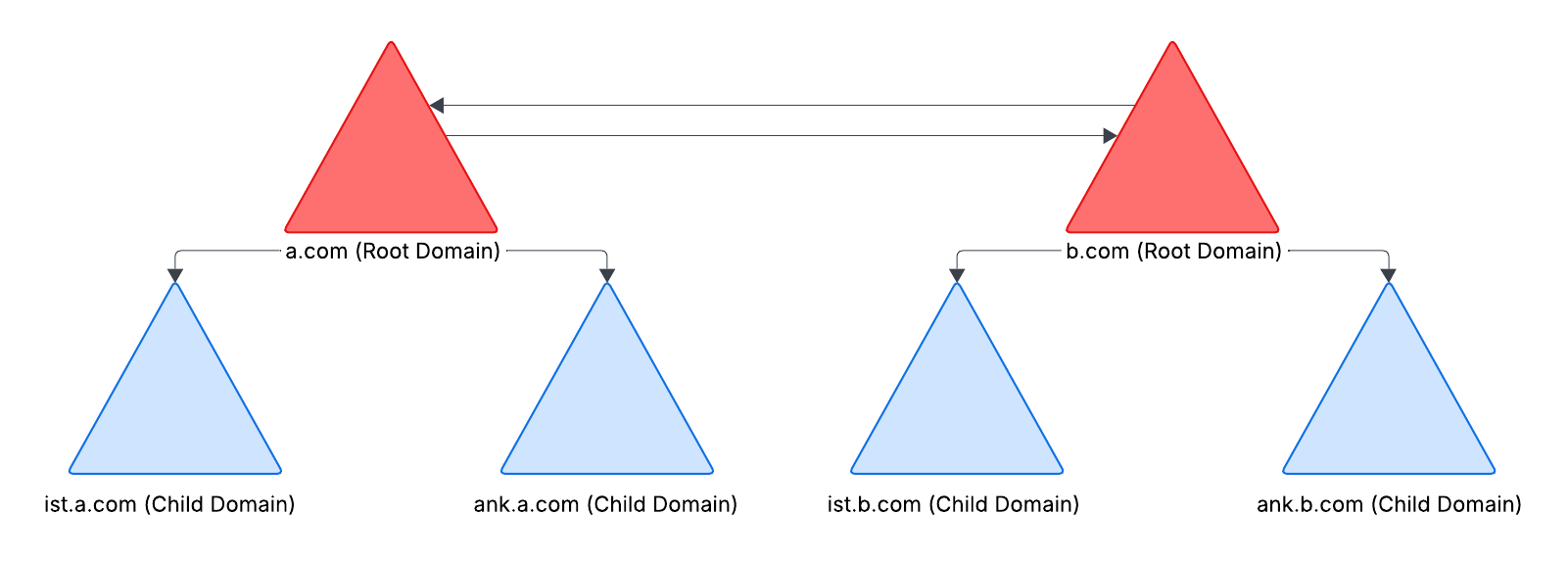
The blue colours in the diagram represent the domains that are outside the scope of the non-transitive trust. This structure shows that the trust relationship is valid only between the defined root domains (a.com and b.com) and never extends automatically to the child domains.
Microsoft handles user-based authentication traffic over an external trust mainly with NTLM. Because of the structure of an external trust, the Kerberos cross-realm referral mechanism does not operate fully as it does in a forest trust; for this reason, in modern scenarios a forest trust is the more consistent choice for Kerberos-based authentication compatibility. Considering the security weaknesses of NTLM (NTLMv1 is deprecated, NTLMv2 offers limited protection), a forest trust should be planned instead of an external trust whenever possible.
In addition, SID Filter Quarantining is enabled by default on external trusts. This feature filters foreign SIDs in the access token that comes from the other side of the trust and protects against SID History injection attacks.
|
Configuration |
Trust direction: a.com ↔ b.com (external trust)
Authentication type: Domain-wide or Selective |
|
Result |
✔ The trust relationship is valid only between the a.com and b.com domains.
✔ Child domains such as ist.a.com, ank.a.com, ist.b.com and ank.b.com are not included in this trust relationship.
✔ The trust is defined only between these 2 root domains and, because it is non-transitive, never extends to the child domains. |
3- External Trust (Non-Transitive - Child to Root)
The external trust in this scenario is a non-transitive trust relationship created between a root domain in 1 forest and a child domain in another forest. This structure keeps the trust valid only between the 2 specified domains and does not extend it to the forest level. For example, an external trust established between a.com and ist.b.com allows authentication only between these 2 domains. Other domains in the same forest, such as b.com or eu.b.com, are not affected by this relationship. The trust model is therefore limited per domain, and access takes place only between the 2 explicitly defined domains.
This approach is generally preferred when specific child domains in an organisation's infrastructure need access to an external structure. When a trust configuration at the forest level is not wanted, establishing a restricted trust relationship only between specific domains is the more secure method. Here, an external trust gives administrators full control over the access scope. Authentication traffic is valid only between the domain pairs for which the trust is defined; no domain other than the child domain is included in this authentication chain.
This model is an effective solution in environments where isolation is important. For example, if users from another forest need to access only specific resources in a child domain of a forest, this access can be managed through an external trust. This keeps the security scope narrow and also prevents uncontrolled identity propagation between forests. This use of an external trust is among the most suitable scenarios for structures that are not unified or for temporary integrations.
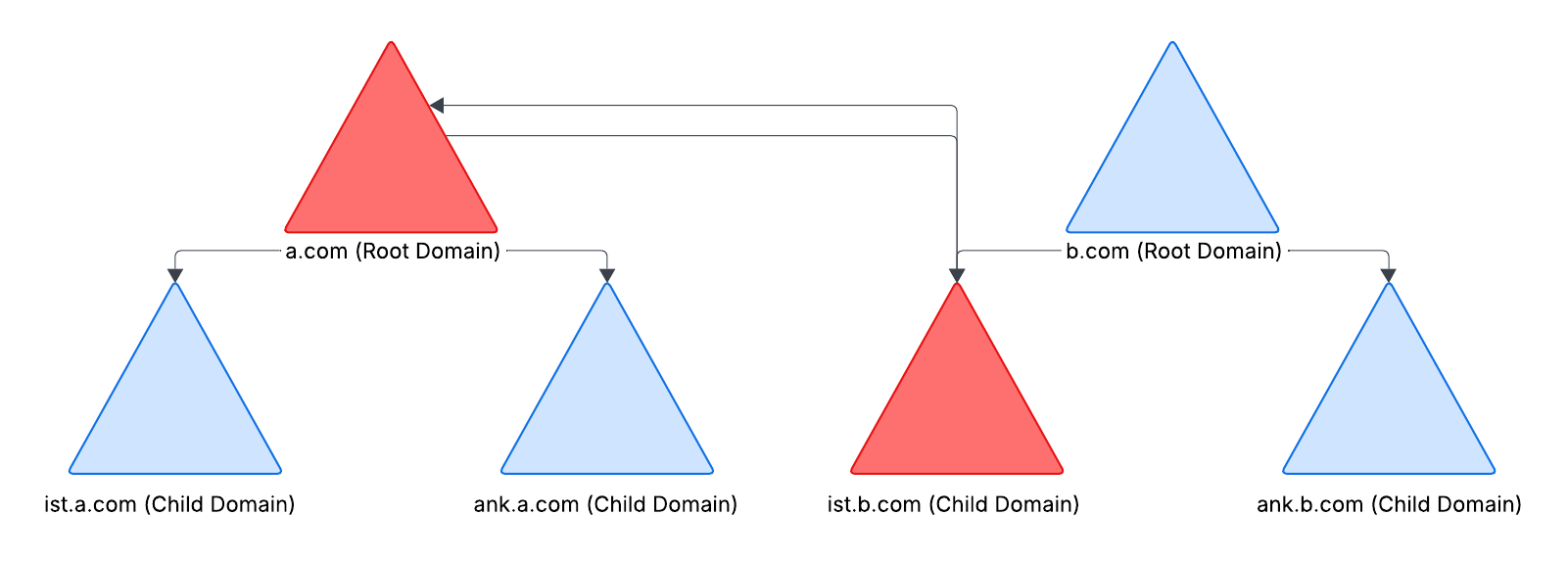
In Microsoft terminology, a "parent-child trust" is a transitive, two-way trust relationship that is created automatically within the same forest between a parent domain and a newly added child domain. The scenario described here, however, is an external trust that is established manually between a root domain and a child domain located in 2 separate forests. For this reason, the scenario should be defined conceptually as a root-to-child external trust; it must not be confused with the intra-forest parent-child trust.
|
Configuration |
Trust direction: a.com ↔ ist.b.com (external trust)
Authentication type: Domain-wide or Selective |
|
Result |
✔ The trust relationship is valid only between the a.com and ist.b.com domains.
✔ b.com, ank.b.com and other domains are not included in this trust relationship.
✔ The trust is defined only between these 2 domains and, because it is non-transitive, does not extend to parent or child domains. |
4- External Trust (Non-Transitive - Child to Child)
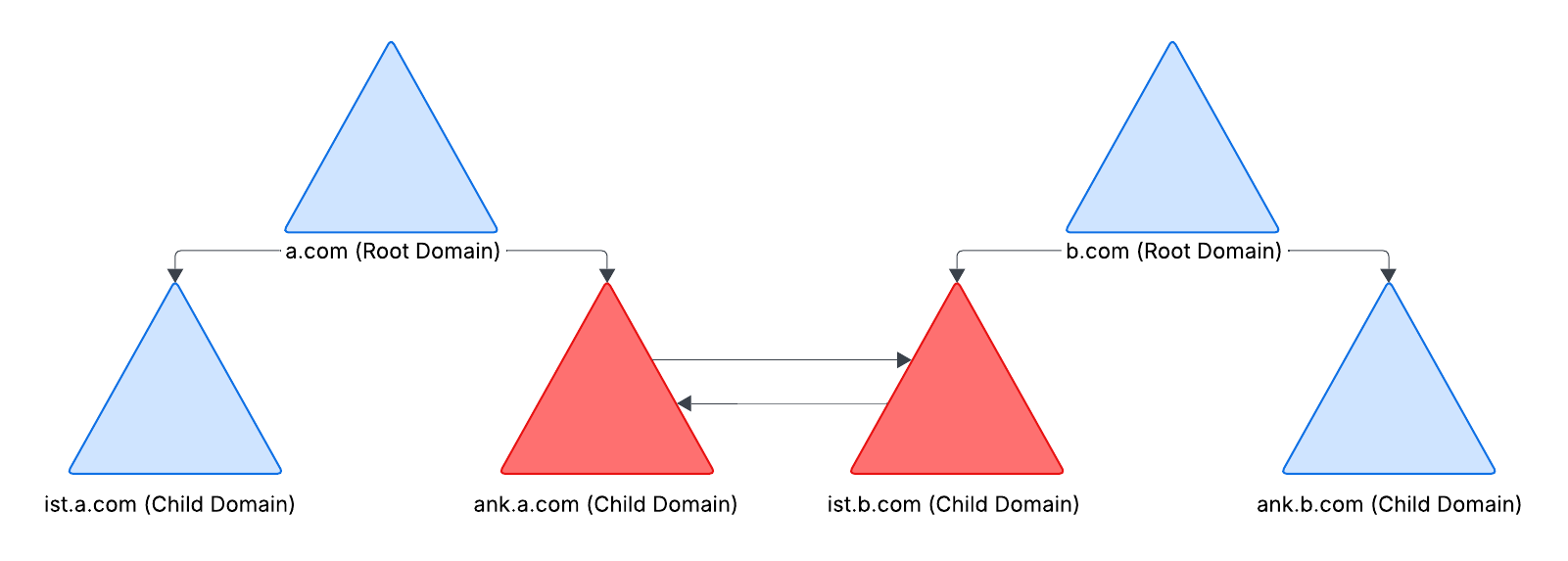
The external trust in the child-to-child scenario is a non-transitive trust relationship created between 2 child domains in different forests, and its scope is limited to these domains only. In this model, the trust is not passed to the parent domains or to the other child domains in the same forest. This means that an external trust defined between ank.a.com in the a.com forest and ist.b.com in the b.com forest allows authentication only between these 2 domains. a.com, b.com and the other child domains (for example ist.a.com and ank.b.com) are not included in this trust chain.
This approach is generally preferred when specific child domains need to authenticate directly with each other but a trust definition at the forest or root domain level is not wanted. A secure connection is established between the 2 child domains, but this trust relationship never extends to the forest or to other domains. Because the trust is structurally non-transitive, authentication takes place only between the explicitly defined domain pairs.
In this scenario, authentication traffic is valid only between ank.a.com and ist.b.com. The root domains and the other child domains in both forests are not included in this authentication traffic. When access must be limited to the domains of specific business units, this structure is the most suitable method for both security and administrative balance.
|
Configuration |
Trust direction: ank.a.com ↔ ist.b.com (external trust)
Authentication type: Domain-wide or Selective |
|
Result |
✔ The trust relationship is valid only between the ank.a.com and ist.b.com child domains.
✔ a.com, b.com and the other child domains (ist.a.com, ank.b.com) are not included in this trust relationship.
✔ The trust is defined only between these 2 domains and, because it is non-transitive, does not extend to parent or child domains. |
This article covered the technical details that distinguish forest trust and external trust structures in Active Directory environments, beyond conceptual definitions, from the perspective of replication boundaries and trust relationships. The effects of basic parameters such as trust direction, transitivity and authentication types on the structure were explained through example domain scenarios. The article showed clearly that choosing a trust type is not limited to creating a connection; it is also directly related to components such as access scope, the security boundary and DNS configuration.
An external trust is mostly configured between 2 specific domains, and because this relationship is non-transitive, the trust is valid only between the directly defined domains. This structure is generally preferred when the access requirement between different forests is minimal. A forest trust, in contrast, creates a transitive relationship and forms a trust chain that covers not only the root domains but all child domains. This makes it more functional in scenarios that require extended access.
The article also analysed in detail how the Forest-wide and Selective options for the authentication type affect the level of access that user and group objects have to resources in the target forest. In particular, when Selective authentication is chosen, access control remains per object even though the trust relationship exists, which gives more granular control for security. Selective authentication requires the "Allowed to authenticate" permission (ACE) to be defined explicitly on the server or computer account that hosts the target resource; unless this permission is granted, a user on the other side cannot authenticate to that resource even when the trust exists. In addition, because SID filtering is enabled by default, identities that come from external sources cannot cause unexpected effects. This shows that a trust configuration is not only an installation task and must also be handled carefully from a security point of view.
When trust configurations are combined with topics such as DNS resolution, trust direction (inbound, outbound, bidirectional) and user visibility, it becomes clear that settings made only on the trust screen are not enough for the configuration to work correctly. A trust is not only a bridge in the Active Directory architecture; it is also a controlled gateway through which access, auditing and visibility policies extend. In this context, understanding the difference between a forest trust and an external trust is a basic requirement, not only when building the structure but also for managing interaction between domains securely and consistently.
I hope you find it useful...
Feel free to share your thoughts and questions about this article in the comments below. Every contribution helps the content reach more people and makes for a more useful discussion.